
This article is part of our special guide to outdoor kitchens. To view our guide to designing outdoor kitchens, click here !
Key points for choosing the right location
Water, electricity, and gas supply
It is essential to consider water and electricity supply when planning to create an outdoor kitchen.
Water inflows and outflows
To connect your sink to a water supply, you have two options :
- connection to a garden hose.
- direct connection to a drain (consult a professional if necessary).
The simplest and quickest solution is to connect to a garden hose. If possible, place your outdoor kitchen close to the hose.
When it comes to drainage, plan for a wastewater drain. The most convenient location will be a kitchen close to the house, as you can easily connect your kitchen to a wastewater drain.
Electricity
Direct connection is the most suitable solution.
The main points you need to remember:
- waterproof outlet with minimum 16A fuse.
- grounded outlet.
- keep the outlet away from water (faucet, swimming pool).
Note : Be careful when using a standard extension cord. For your safety, we recommend using a waterproof extension cord if you have no other choice.
Gas
There are two connection options if you have a gas appliance :
- to a gas cylinder
- or directly to the mains gas supply (you can ask a professional to assist you).
Drafts
Often overlooked, drafts can blow smoke back toward your guests or into your home. Never place your outdoor kitchen in a wind corridor. Here are some guidelines based on where you live :
- Mediterranean : avoid the far west (frequent winds due to the mistral and tramontane + strong sunshine), opt for an east or northeast orientation.
- Atlantic : avoid the west (with ocean winds), opt for a south or southeast orientation to enjoy the sun and protect yourself from the wind.
- windy areas (e.g., the Basque coast) : choose a location against a windbreak wall.
- mountainous areas: a south or southwest location will allow you to benefit from the sun to warm the space, while protecting it from the prevailing cold north winds.
Choosing the soil
The most important thing when choosing your floor is to choose a stable and flat surface! This will allow you to :
- easily adjust the height of your kitchen cabinets.
- ensure maximum stability for your kitchen.
When it comes to flooring, anything is possible! Just as you should choose durable materials for your outdoor kitchen, select waterproof materials that are easy to clean, such as tiles or waterproof stone.
Please note that if you choose a wooden floor, it must be made of exotic wood, which is naturally resistant to UV rays and rain, otherwise your floor will deteriorate quickly (in addition to requiring frequent maintenance).
In any case, be sure to cover your floor with a stain-resistant treatment. You can also protect your floor with a protective mat.
The different places where you can put your outdoor kitchen
Under a pergola or canopy
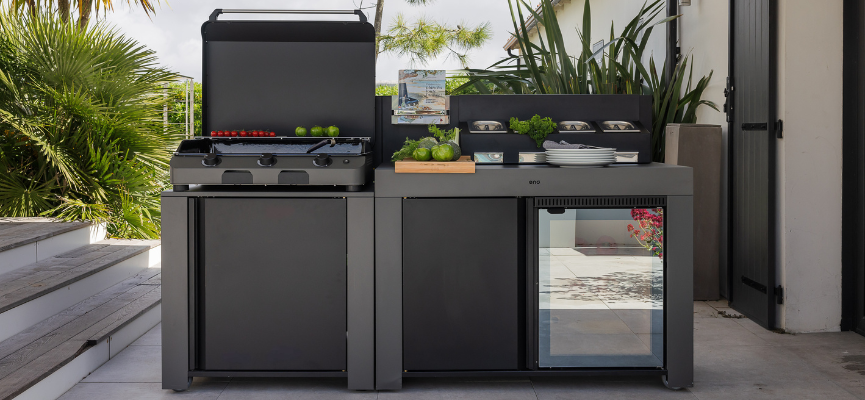
We highly recommend placing your outdoor kitchen under a pergola (with a closed roof) or an awning. This is the most advantageous solution, both in terms of maintenance and the durability of your furniture.
The main advantage of placing your kitchen under a pergola or awning is that you can enjoy shade in summer, allowing you to escape the sometimes stifling heat of the summer months.
In winter or during rainier seasons such as fall, a pergola or awning is an excellent way to cover your outdoor kitchen and protect it from rain and wind (provided the pergola has a waterproof, closed roof). No more rushing to put everything away when a heavy shower hits—you can keep cooking !
Our tips for choosing the right pergola :
Choose a covered pergola (to protect your kitchen), equipped with a sunshade to protect you from the sun while allowing air to circulate (recommended for summer) :
- between 5m² and 20m² (ideal for building an outdoor kitchen and dining area), you will need to submit a preliminary declaration of works to your local town hall
- above 20m², a building permit will be required.
Against the house or an adjoining terrace
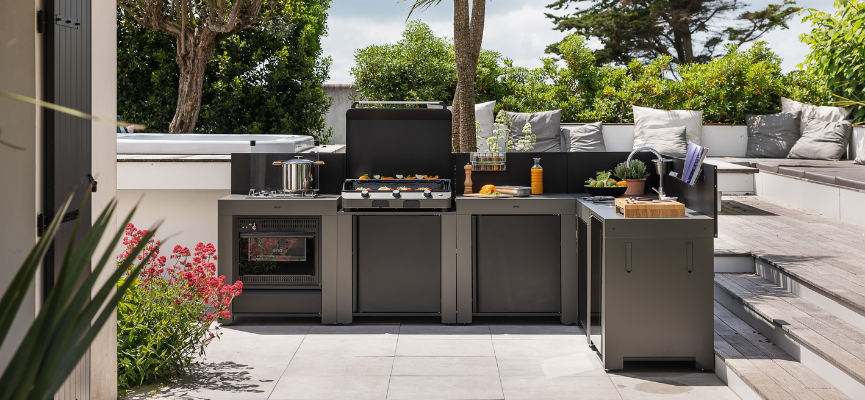
Placing an outdoor kitchen against the house or on the terrace is a choice made by many people because of the practicality of the location. Offering an extension of the house to the outside with the terrace, an outdoor kitchen placed in this location will provide :
- unmatched practicality : thanks to its proximity to the house, you can easily fetch any missing utensils or ingredients, ensuring maximum fluidity when preparing and serving meals.
- easy connections : it will be easier for you to connect a water supply (a sink, for example), an electrical appliance, or a gas appliance.
- wind protection : a facade wall will provide natural protection from the wind.
- maximum stability : whether tiled or wooden, a terrace provides a stable, flat surface that is perfect for an outdoor kitchen.
However, please be aware of the following points :
- space between the wall and your kitchen: often overlooked, this is one of the most important aspects to consider when installing an outdoor kitchen against the house. Ensuring there is enough space between the wall and your cooking area will reduce staining on your wall from splatters or smoke.
- ENO outdoor kitchen cabinets are equipped with 30 cm high backsplashes to protect your walls from splatters!
- the size of your patio : installing a kitchen adjacent to the house is most often done on an existing patio. If the patio is too small, you will not have enough space to set up a dining area and cook comfortably.
- indoor nuisances : if your wall has windows, smoke can rush in. Be careful, this is not a deal breaker but something to consider. We live with our windows open in summer, so be vigilant about smoke circulation.
You can also set up an outdoor kitchen on a rooftop terrace (example of an ENO outdoor kitchen on a terrace created by the Pousse agency in Paris) :

Copyright: Pousse paysagiste
Near the pool
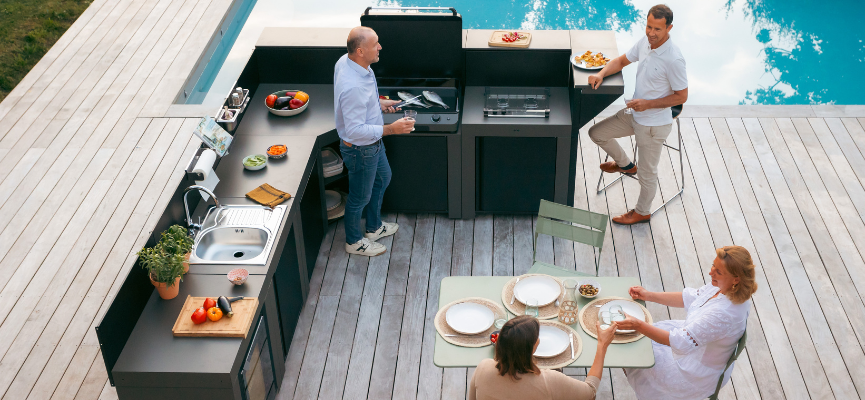
You can easily install your outdoor kitchen near your pool for a guaranteed pool party atmosphere! The main advantage of this location is that the ground is already “ready” to accommodate a kitchen (leveled and flattened), which will make installation easier.
However, be mindful of three points :
- the safety of your floor : make sure your floor is non-slip to prevent falls. If you have an electric cooking appliance (such as a griddle), make sure you have waterproof sockets to avoid any risk of electrocution.
- traffic flow : consider the traffic flow around your pool. Your kitchen should not obstruct access to the pool or the relaxation area where your deck chairs may be located.
- ideally, your outdoor kitchen should be set back slightly from your pool (allow for about 2 meters of space), which will allow you to set up a bar counter near your pool and enjoy a drink by the water!
- pergola or awning : placing your outdoor kitchen under a pergola or awning will protect it from water and wind.